

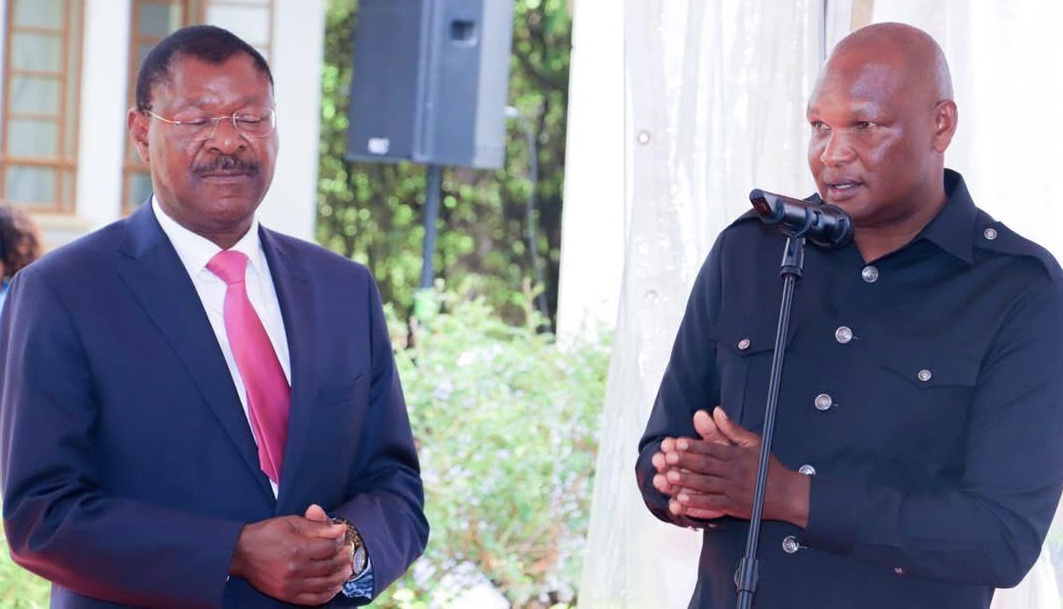
National Assembly Speaker Dr Moses Wetang’ula with President Ruto’s PA Faouk Kibet.Mr Kibet endosed Wetang’ula on Sunday to succeed President Ruto in 2032…..Photo/CG
By Peter Marango Mwibanda
NAIROBI, Kenya
As Kenya slowly marches toward the 2027 General Election, political conversations are no longer confined to who will challenge President Dr. William Ruto.
Increasingly, attention is shifting to an even bigger question: who will inherit political power after him?
Recent remarks attributed to individuals within President Ruto’s inner circle suggesting support for National Assembly Speaker and Ford Kenya leader Dr. Moses Wetang’ula as a potential presidential candidate in 2032 have ignited fresh debate across Kenya’s political landscape.
The comments have raised eyebrows for one simple reason: Kenya already has a Deputy President, Kithure Kindiki, whose constitutional role traditionally places him closest to succession should President Ruto complete his second term.
The emerging debate exposes what may be the earliest signs of a succession contest within the Kenya Kwanza coalition itself.
Reading From Different Scripts?
In every political administration, succession politics begin long before official campaigns.
The endorsement of Wetang’ula, whether strategic or accidental, introduces an uncomfortable question for the ruling coalition: Is the political establishment reading from one script or multiple competing scripts?
Kindiki’s elevation to the deputy presidency positioned him as one of the most influential figures in government.
Historically,vice /deputy presidents have often been viewed as natural heirs to outgoing administrations.
Yet Kenyan politics has never followed a predictable succession formula.
Former Vice President Kalonzo Musyoka spent years as a deputy without ascending to the presidency.
Former Deputy President Rigathi Gachagua discovered how quickly political fortunes can change…same to Jaramogi Oginga Odinga,Joseph Murumbi,Prof Josephat Karanja,Prof George Saitoti and Prime CS Musalia Mudavadi.
The speculation surrounding Wetang’ula therefore signals that the battle for 2032 may already be underway, even as the country prepares for the more immediate contest of 2027.
The Opposition’s Emerging Coalition
While attention remains focused on State House, opposition forces are quietly reorganizing.
Former Interior Cabinet Secretary Fred Matiang’i has emerged as a significant figure within circles associated with former President Uhuru Kenyatta.
Matiang’i carries the image of a technocrat, administrator and disciplinarian.
His supporters believe Kenya’s economic challenges and governance concerns have created an appetite for managerial leadership rather than populist politics.
At the same time, Kalonzo Musyoka continues to position himself as perhaps the most experienced opposition figure still actively pursuing the presidency.
After decades of political relevance, Kalonzo is presenting himself as a statesman capable of uniting disparate opposition factions under one banner.
Whether the opposition settles on a single candidate or enters the race fragmented may ultimately determine President Ruto’s political future.
The Edwin Sifuna Factor
Perhaps the most fascinating development is the growing national profile of Nairobi Senator Edwin Sifuna.
Among many young voters, particularly urban Gen Z populations, Sifuna has emerged as a powerful political communicator.
Unlike traditional politicians whose appeal often relies on ethnic arithmetic and patronage networks, Sifuna’s popularity is increasingly driven by issue-based politics, social media engagement and direct criticism of government policies.
His rise reflects a broader generational shift occurring within Kenyan politics.
For decades, presidential politics revolved around liberation figures and long-established political dynasties.
Today’s younger electorate appears less interested in historical loyalties and more concerned with economic opportunities, governance reforms, accountability and transparency.
Whether Sifuna eventually seeks the presidency or remains a kingmaker, his influence cannot be ignored.
The growing appeal of Gen Z-driven politics could become one of the defining features of the 2027 election cycle.
The End of Traditional Political Mathematics?
Kenya’s political history has often been defined by ethnic coalitions and regional voting blocs.
However, recent public discourse suggests a gradual shift.
High unemployment, rising public debt, cost-of-living pressures, corruption scandals and growing public frustration with political elites are creating conditions where traditional political calculations may no longer be sufficient.
The youth-led demonstrations witnessed in recent years demonstrated an unprecedented phenomenon: young Kenyans organizing across ethnic, religious and regional lines.
This emerging political consciousness presents both opportunities and risks for established politicians.
Candidates who fail to connect with younger voters may discover that traditional mobilization strategies no longer guarantee electoral success.
What 2027 Means for 2032
The 2027 election is no longer merely about whether President Ruto secures a second term.
It is rapidly becoming a contest that will define Kenya’s political order for the next decade.
A Ruto victory would strengthen Kindiki’s prospects while simultaneously elevating other ambitious figures such as Wetang’ula.
A united opposition victory could completely redraw the country’s political map and produce an entirely new succession hierarchy.
Meanwhile, younger leaders like Edwin Sifuna represent an emerging force capable of disrupting established political calculations.
The Bigger Picture
The struggle unfolding in Kenya is not simply a battle between politicians.
It is a contest between political generations, governance philosophies and competing visions for the country’s future.
One camp argues for continuity and stability. Another demands accountability and reform. A third seeks generational renewal.
As political realignments gather momentum ahead of 2027, Kenya’s voters will increasingly find themselves confronted with a fundamental choice: whether to preserve the old political architecture or embrace a new era shaped by younger leaders and changing public expectations.
The succession debate may have started with questions about who follows President Ruto.
But beneath the surface lies a deeper question that will define Kenya’s democratic future: what kind of leadership do Kenyans want in the decades ahead?
For now, the chessboard is set. The players are positioning themselves and the opening moves of Kenya’s next great political contest are already underway.