

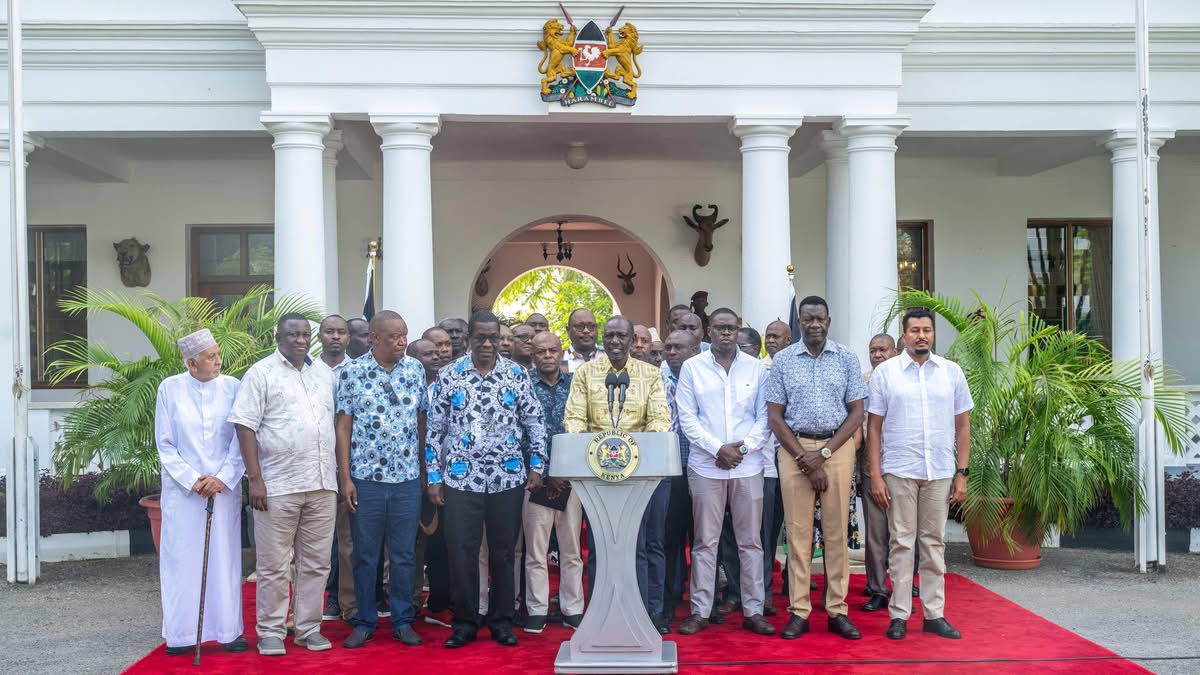
President William Ruto addresses the nation from Mombasa flanked by top government officials on Friday….Photo/Courtesy
By CG reporter
MOMBASA, Kenya
The policy, broadcast live from State House Mombasa, applies to both public service and private vehicles.
In a delightfully ironic twist, the government is introducing tax holidays for high-tech imports just as ordinary motorists wonder if they can afford to fuel their current internal combustion engines long enough to drive to an EV showroom.
For the local transport sector, the implications are beautifully chaotic. Nairobi’s famous, noisy, smoke-belching diesel matatus (minibuses) are expected to transition into near-silent, battery-powered eco-pods.
This leaves commuters to wonder if the traditional, aggressive matatu culture can survive without the comforting aroma of exhaust fumes.
The financial ripple effects are hitting Mombasa’s used car importers like a rogue wave.
These dealers, already reeling from the Kenya Revenue Authority (KRA) policy shifting to physical inspections—which inflated duties on traditional cars by over 80 percent—must now compete with tax-free electric imports.
EV buyers can confidently bypass the standard 10 percent import duty on completely knocked-down units, alongside hefty taxes on parts.
Meanwhile, Kenya Power is preparing for a prospective surge in overnight charging demand. Optimists argue that late-night charging will bridge the off-peak energy gap.
Skeptics, however, point out that Kenya’s interconnected grid capacity has been frozen at 3,192 MW since late 2024.