
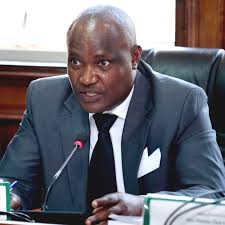
Treasury CS John Mbandi….CG
NAIROBI, Kenya
The National Treasury has officially unveiled a record Sh4.8 trillion national budget for the 2026/2027 fiscal year, balancing a massive Sh1.1 trillion funding deficit against heightened spending commitments aimed at rural and regional transformation.
While Cabinet Secretary John Mbadi presented the sweeping national tax administration goals and recurrent expenditure frameworks to lawmakers, the fiscal layout signals an aggressive funding pivot toward agriculture, health and transport networks across the economic powerhouses of Western Kenya: Bungoma, Kakamega and Trans Nzoia counties.
Local County Budgets Under Intense Pressure
Following a fresh mediation pact by the Parliament of Kenya that unlocked an expanded national equitable share pool of Sh428 billion for local governments, the regional hubs have consolidated their medium-term spending frameworks:
- Kakamega County: Formulated a massive Sh16.7 billion total budget proposal, with Sh11.58 billion absorbed by recurrent costs and salaries, leaving Sh5.18 billion strictly reserved for development projects.
- Trans Nzoia County: Anchored its Annual Development Plan around a total framework exceeding Sh9.5 billion, buoyed by a baseline equitable share allocation of KES 7.9 billion.
- Bungoma County: Advanced its Sh14.5 billion medium-term financial projection, aiming to aggressively tracking local domestic collections alongside national transfers
Local business groups, including the Kenya National Chamber of Commerce and Industry (KNCCI) Trans Nzoia branch, urged the state to aggressively prioritize local commerce to lift the economic burden off independent traders.
Bungoma Targets Sh1.87 Billion Own-Source Revenue
To secure funding independence from delayed national treasury disbursements, Bungoma County is implementing a rigorous Revenue Enhancement Action Plan (REAP) co-developed with the Commission on Revenue Allocation and the World Bank.
The county projects its structural Own Source Revenue (OSR) potential at KES 1.87 billion annually, relying heavily on three core regional revenue pillars:
| Revenue Sector | Annual Projected Potential |
|---|---|
| Hospital & Public Health Fees | KES 421.88 million |
| Trade & Business Licensing Fees | KES 283.75 million |
| Agricultural Transportation Fees | KES 255.12 million |
Direct Infrastructure Investments Take Center Stage
The centerpiece of the regional shift is a massive infrastructure layout designed to unlock transport blockages between Western Kenya and neighboring East African markets.
- Concession Funding: Private investors are projected to inject Sh184 billion to Sh200 billion into regional transport networks, utilizing future toll fees to recover capital.
- Road Network Boost: The Kakamega County Assembly expanded its domestic roads, public works, and energy docket to Sh1.31 billion to ease market access for farmers.
- Bitumen Upgrades: Backed by the second phase of the World Bank-supported Kenya Urban Support Program (KUSP II), Trans Nzoia is fast-tracking the construction of critical county road links to bitumen standards.
- Bungoma 24-Hour Economy: Installation of multi-grid streetlights across commercial borders including Lwakhakha, Webuye, and Bukembe to protect traders and enable round-the-clock market activity.
Agricultural Revitalization and Healthcare Delivery
The government’s overarching Bottom-Up Economic Transformation Agenda (BETA) is leaning heavily on the region’s agricultural output to guarantee national food security and minimize the country’s reliance on food imports.
The Treasury has earmarked portions of the Sh99.9 billion national agriculture budget to finance local edible oil value chains, palm seedling distributions and subsidized inputs.
Locally, Kakamega has dedicated Sh597.4 million to bolster crop and livestock production, while Trans Nzoia is driving agro-industrialization.
In Bungoma, targeted capital is scheduled to finish the upgrading of Amutala Stadium alongside localized climate mitigation projects under the Finance Locally Led Climate Action (FLLOCA) program.
Simultaneously, a regional slice of the Sh214.8 billion health docket will deploy funding directly to the Social Health Insurance Fund (SHIF) to support community health promoters.
Bungoma has locked in dedicated funding to finish, upgrade, and resource the Makhonge Health Centre, Chwele Health Centre and Sinoko Health Centre to smoothly integrate with the national SHIF framework.
Taming the Recurrent Bill to Protect Capital Projects
The greatest challenge hanging over the regional economic expansion plans is a ballooning recurrent expenditure framework.
Internal payroll tracking reveals that personal emoluments, statutory pensions and administrative costs continue to eat up over 35% of local revenue pools across the counties.
To keep development alive, county treasuries are instituting aggressive spending caps on non-essential operational lines.
Subsidies for foreign travel, hospitality, and generic office supplies are being rolled back to direct maximum liquidity into physical asset creation.
Furthermore, county finance officers are implementing stricter automated internal oversights to solve historical low budget-absorption constraints.
This mechanism guarantees that development funds translate directly into finished civic works on schedule, rather than rolling over unspent into the next year.