

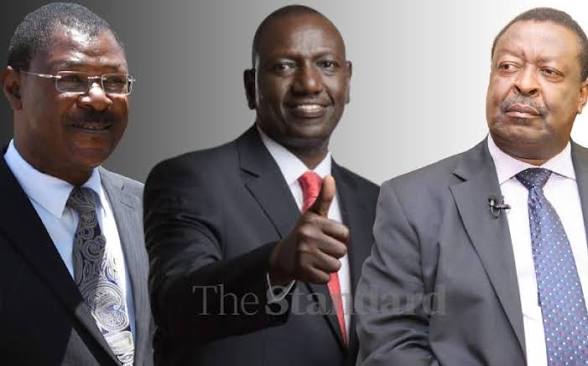
Mulembe veteran politicians Dr Moses Wetang’ula (left)and Prime CS Musalia Mudavadi(right) with President Ruto (center)at a past function…..Photo/CG
By Peter Marango Mwibanda
(Political and Legal Analyst)
For decades, Western Kenya has proudly occupied a central place in Kenya’s political history.
The region has produced national leaders, influential legislators, cabinet ministers, diplomats,policy makers,spiritual giants and powerful voices in Parliament.
Yet beneath the symbolism of political representation lies an uncomfortable question: Why does a region that has contributed so much to national leadership continue to struggle with poverty, unemployment, poor infrastructure, and economic stagnation?
The answer increasingly being whispered in villages, markets, universities and social media platforms is simple: political loyalty has often been rewarded more than transformative leadership.
A culture of political sycophancy has gradually taken root within sections of the Western Kenya political establishment.
Too many leaders appear more interested in aligning themselves with the ruling regime of the day than confronting the realities facing ordinary citizens.
Whether under one administration or another, the script rarely changes. Leaders rush to endorse government agendas, defend unpopular policies and celebrate political appointments while their constituents continue to grapple with economic hardship.
The result is a widening disconnect between political elites and the people they claim to represent.
Today, the youth of the Mulembe nation are asking difficult questions.
Why should leaders be celebrated for securing positions for themselves, their relatives, friends, and political allies while communities continue to lack meaningful investment and opportunities?
Why should political handouts be mistaken for development? Why should loyalty to power outweigh accountability to the people?
These questions are fueling what may become one of the most significant political shifts in the region’s modern history.
A new generation is emerging—one that is less interested in tribal kingpins, political patronage, and personality cults.
This generation is connected, informed, digitally empowered and increasingly unwilling to accept politics based on fear, favors, and empty promises.
The traditional politics of chieftaincy, where a few powerful individuals determined the political direction of millions, is facing unprecedented resistance.
The youth are challenging inherited political structures and demanding leadership based on ideas, performance, integrity, and results.
Across the country, Gen Z has fundamentally altered Kenya’s political conversation. The language of accountability is replacing the language of blind loyalty.
Citizens are beginning to view themselves not as subjects of political patrons but as employers of public servants.
This transformation is particularly significant for Western Kenya.
For generations, many voters have supported leaders based on ethnic solidarity and political symbolism. Yet the economic indicators tell a troubling story.
Large sections of the region continue to struggle with youth unemployment, inadequate healthcare, poor agricultural returns and limited industrial growth despite decades of political prominence.
The emerging political consciousness is therefore not merely about changing faces.
It is about changing the entire philosophy of leadership.
As Kenya approaches the 2027 elections, the message from many young voters appears unmistakable: public office is not a reward system for political loyalty.
It is a responsibility to deliver tangible results.
The Mulembe nation stands at a historic crossroads. It can continue embracing politics driven by personalities and patronage or it can champion a new era defined by accountability, competence and visionary leadership.
The winds of generational change are already blowing across the region.
Whether the political establishment chooses to listen may determine not only its future but also the future prosperity of millions of people who have waited far too long for the promises of development to become reality.
For many in Western Kenya, 2027 is no longer simply an election year.
Ends.