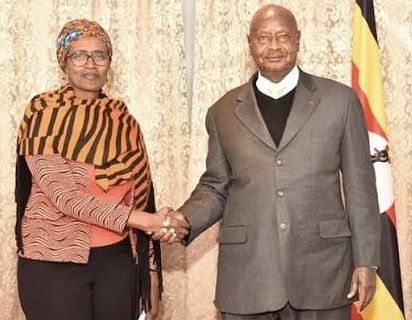
President Mueeveni with Winnie Byanyima in a past function…..Photo/CG
Winnie Byanyima, executive director of UNAIDS, has issued a sharp rebuke to Ugandan President Yoweri Museveni following his recent comments mocking unemployed youths who leave the country to seek jobs in the Gulf region.
In an open letter dated June 5, 2026, Byanyima expressed profound sadness over the president’s remarks, which targeted young Ugandans migrating to destinations like Dubai, Saudi Arabia, and Qatar.
She stated that these young men and women leave not from a lack of patriotism, but due to a critical shortage of economic opportunities at home.
“These young men and women are not leaving because they do not love Uganda,” Byanyima wrote. “They are leaving because they cannot find sufficient opportunities at home.”
Background of the Dispute
The public dispute was triggered by President Museveni’s recent address calling out the growing trend of casual labor migration.
Museveni questioned why citizens leave a resource-rich home country for Middle Eastern hubs.
“Why should people go to the desert of Dubai to look for jobs when we Ugandans are living in paradise?” Museveni said. He further blamed the migration trend on an “inferiority complex, ignorance, and poor leadership”, prompting a severe public backlash regarding the state of the domestic economy.
Economic Contribution of Foreign Workers
Byanyima highlighted that remittances from the diaspora serve as one of Uganda’s primary sources of foreign exchange, directly sustaining millions of households.
She argued that rather than being a burden or a subject of ridicule, these workers deserve respect for the immense sacrifices they make to support their families.
Turning the focus toward governance, Byanyima directly attributed the migration trend to structural economic failures under Museveni’s nearly 40-year administration.
She pointed out that job creation has failed to keep pace with a population that has more than doubled during his tenure.
Byanyima criticized the government’s historic reliance on sweeping privatization and liberalization without implementing active, labor-intensive industrial policies, strategic tourism investments, or a robust transformation of the agricultural sector.
Comparison to Regional Neighbors
Drawing comparisons to regional neighbors, Byanyima noted how Kenya, Tanzania and Rwanda have successfully leveraged strategic public investment, infrastructure and destination branding to turn tourism and conservation into massive job-creating engines.
She noted that Rwanda often out-earns Uganda in tourism revenue per visitor, despite Uganda housing nearly two-thirds of the world’s remaining mountain gorillas.
The report notes structural inequalities where youth with post-primary specialized training face a staggering 28.2% unemployment rate, indicating that the local market simply cannot absorb graduates at scale.
Byanyima also identified widespread corruption and nepotism as major “job killers” that lock out talented youth without political connections.
Concluding the letter, Byanyima called for transparency and structural accountability rather than lectures.
She challenged President Museveni to make a public pledge to publish certified job-creation metrics every month.
“Do not mock the youth who leave,” Byanyima urged. “Answer the question they are asking. After nearly four decades in power, where are the jobs?
While the State House defended its economic record by pointing to the Parish Development Model and infrastructure projects, official data indicates significant employment gaps, with urban youth facing a 28.2% unemployment rate and rural areas struggling with low-productivity, according to analysis.
Ends.