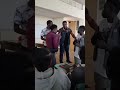
Habbakuk Mwasame(left),the late Clinical Officer Robert Kundu and Mwalimu Charles Abai…..Photo/courtesy
By HABBAKUK NYONGESA MAFURA
(Narrative Features Specialist)
MALINDI, Kenya
This is the account of three childhood friends from different families—a narrative defining shared history, personal ambitions and the shifting dynamics of life in rural Kenya.
Originally intended as a screenplay for an open-field holiday screening, the chronicle of their shared youth is transitioning into print prior to its theatrical debut.
The Diaspora Migration and Holiday Returns
For many professionals working outside their home counties—historically referred to locally as working in the “diaspora”—national public holidays offer a strategic window to return to rural villages.
By anchoring annual leave around the Easter season, urban workers can secure extended periods to audit family developments and reconnect with local networks.
During the recent Easter holiday, this reporter utilized an eight-day window away from professional duties to travel upcountry.
Following a standard regional transit protocol, the journey commenced from the coastal town of Malindi to Bungoma town via a Mash Poa bus .
Habbakuk aka Habs arrived at the booking station (Malindi)two hours before departure to mitigate the operational delays typical of holiday travel.
Following a designated day of recovery from the cross-country road transit, a routine inspection of family agricultural holdings in Bungoma commenced, accompanied by family members.
An Unexpected Reunion at the Fence Line
While surveying the farm boundary, a chance encounter occurred with a childhood contemporary, Charles Abai, a teacher at Malakisi .
“Habs, it is you,” Abai said as he approached the perimeter. “It has been a while. I see you are out here inspecting projects to verify the efficiency of remittances sent back home.”
Charles Abai cleared a passage through the wire fencing to facilitate entry into the family compound.
The homestead accommodated several returning family members including the family patriarch, Jackson Abai, alongside Sarah and Rebecca Abai, and two younger siblings, Ken and Nickson Abai.
The family had similarly leveraged the statutory holidays to execute a temporary return to the village.
Digital Chronicles Spark Local Inspiration
The ensuing discussion revealed that the Abai family had been closely tracking regional historical documentation published under the digital series banner, “#MyStoriesInAPhoto.”
Family members expressed particular resonance with an earlier installment titled, “The Matriarchs Who Shaped Me,” which documented the generational influence of women in the locality.
The digital footprints prompted a proposal to formalize the group’s collective upbringing into a structured screenplay.
“Bro, you need to write a script about us from when we were barefoot kids up to now,” Charles Abai proposed during the discussion.
“Imagine screening it at ACK Lwandanyi Primary School! It would feel exactly like back in the day, watching those open-air mzungu cinemas projected onto a white piece of cloth at our church, St. Matthew’s ACK Lwandanyi.”
Historical Context of Lwandanyi and the Bungoma Frontier
The mention of Lwandanyi ACK Primary School anchors the narrative in the deep educational and spiritual history of the former Malakisi division within Sirisia Constituency.
Established under the sponsorship of the Anglican Church of Kenya, the day-mixed institution has historically served as a central socio-educational anchor for the local community.
The broader Bungoma West region carries a legacy deeply influenced by early communication and transit shifts.
The Malakisi area transformed significantly following the arrival of the Kenya-Uganda railway line in 1925, evolving from a modest rural halting point into a bustling commercial market center by 1933.
Historically rich,the county’s identity is defined by the resilient cultural traditions of the predominant Bukusu community, agricultural cooperative movements and historical anti-colonial religious movements like Elijah Masinde’s Dini ya Musambwa, which positioned nearby Mount Elgon as a sacred spiritual epicenter.
For generations in villages like Lwandanyi, the rare arrival of mobile cinema vans—which projected educational or religious films onto makeshift white linen screens pinned to church walls—served as the primary gateway to visual storytelling.
Scaling the Audacity of the 2026 Village Screening
The proposed screenplay is slated to succeed an active multi-chapter literary project titled, “A Dream in the Dark Clouds.”
Once that manuscript concludes, formal resource mobilization will begin to secure infrastructure for a community screening in the village during the December 2026 holiday season.
Reflecting on the historical baseline of the region, the family patriarch underscored the value of maintaining local ties.
“Our history in this border zone has always been preserved through the stories we tell our children by the fireside,” Jackson Abai remarked. “To see our own youth captured on a digital screen where the old mobile cinema vans used to park would show how far this community has come since the early days of the republic.”
Standing within the rural compound, the group acknowledged the logistical complexities of staging an independent film premiere in a rural setting.
However, the conceptual framework remains clear: a finalized script, a localized production and an open-air screening targeting the community that shaped their early lives.
……..The progression of this initiative will be detailed in the forthcoming second installment of this series.