
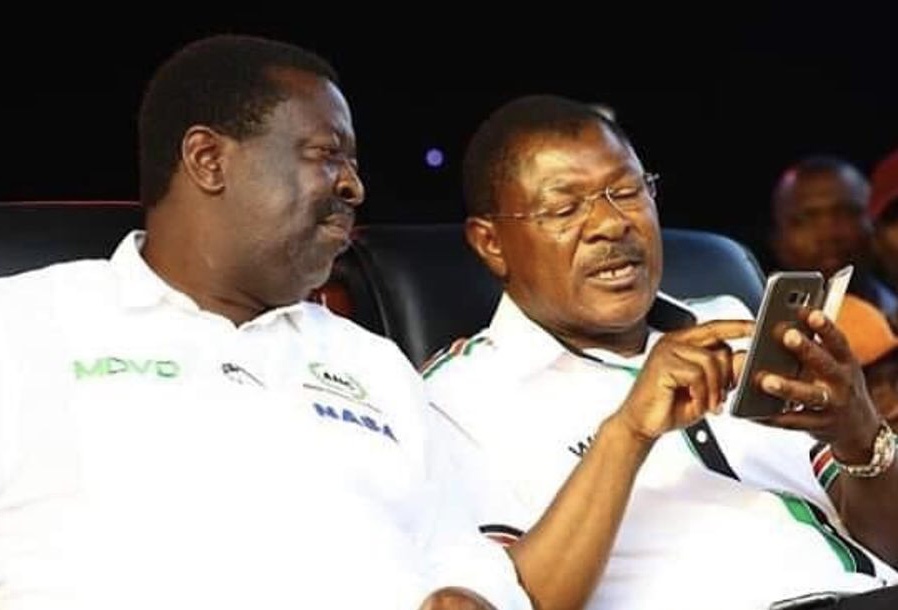
Prime CS Dr.Musalia Mudavadi and Speaker of the National Assembly Dr. Moses Wetang’ula…..Photo/CG
Political commentary
The board is being set quietly, but the intention is anything but subtle.
Assuming current alignments hold, Western Kenya is no longer just a voting bloc—it is a containment zone, and at the center of that containment are Musalia Mudavadi and Moses Wetangula.
Phase One: Crowd the Space (2024–2027)
A network of alternative voices is being elevated—not necessarily to win, but to deny dominance.
“Figures like George Natembeya and Caleb Amisitake on the role of disruptors—keeping the ground politically noisy, fragmenting loyalty, and preventing a clean consolidation behind Mudavadi or Wetang’ula,”said a top UDA official who sort anonimity.
They are allegedly reinforced by local mobilizers such as Majimbo Kalasinga,Wycliffe Wangamati,Zachariah Barasa and Wanami Wamboka in Bungoma alongside narrative shapers like Cleophas Malala and Bounny Khalwale in Kakamega and Godfrey Osotsi in Vihiga.
Objective:
Not to replace Mudavadi/Wetang’ula immediately—but to make sure they don’t command the region uncontested.
Phase Two: Split the Establishment (Inside Game)
While the outside pressure builds, the inside is being managed and diluted.
On paper, William Ruto’s camp still leans on Mudavadi and Wetang’ula as Western anchors but parallel structures are quietly reinforced:
- Kenneth Lusaka, Chris Wamalwa, Dan Wanyama, Fred Kapondi → alternative loyalty centers in Bungoma/Trans Nzoia
- Fernandes Barasa and Ayub Savula → administrative grip in Kakamega
Meanwhile, Wycliffe Oparanya remains a wildcard influence, capable of shifting elite alignment depending on how the ground tilts.
Objective:
Ensure Mudavadi and Wetang’ula are not the only gateways to Western Kenya within government.
Phase Three: The 2027 Loyalty Test
By 2027, the question won’t be who is senior—it will be who can actually deliver votes.
- If Mudavadi and Wetang’ula fail to unify Western, their bargaining power drops sharply
- If the region votes in fragments, it proves they no longer control the bloc
- If alternative leaders show localized strength, they become new negotiation centers(Lusaka,Natembeya and Sifuna the top bets to deputize Prof Kindiki(Ruto side)and Ndindi Nyoro(Kenyatta/Gachagua axis).
Outcome:
2027 doesn’t remove them—it redefines their value
Phase Four: Isolation by Relevance (Post-2027)
Once their electoral leverage is questioned, the shift becomes subtle but decisive:
- Ticket negotiations begin to bypass them
- Emerging figures gain direct access to power brokers
- Their role shifts from kingmakers to participants
This is where the long game kicks in.
Phase Five: 2032 — The Real Endgame
By the time 2032 arrives, the groundwork is complete:
- Western Kenya is no longer controlled by two senior figures
- It becomes a multi-node bargaining region
- Presidential tickets are built around loyalty and recent performance—not legacy
This opens the door for:
- New Western-based kingmakers
- Cross-regional coalitions linking Western dissent to Mt. Kenya,Rift valley powerbrokers and beyond
- A succession race where Mudavadi and Wetang’ula are no longer default power centers
The Bottom Line
This isn’t an open confrontation—it’s a slow political suffocation.
Mudavadi and Wetang’ula are not being pushed out.
They will be crowded, diluted, tested and eventually bypassed.
Western Kenya is being redesigned from a two-man stronghold into a competitive arena—
and in that arena, relevance will not be inherited. It will be proven.