

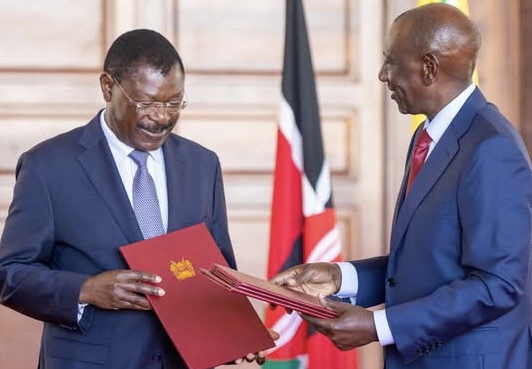
President Ruto and Speaker Wetang’ula at state house on Monday…..Photo/CG
NAIROBI, Kenya
House leaders and the executive have enacted a multi-billion shilling funding boost for local governance, raising the financial stakes for regional administrators to deliver on grassroots development.
President William Ruto signed the Division of Revenue Bill, 2026, into law on Monday, unlocking KSh 428 billion for Kenya’s 47 county governments.
The newly approved legislation represents a KSh 13 billion increase from the previous financial year and sets aside an additional KSh 10.25 billion specifically for the Equalisation Fund to support historically marginalized regions.
National Assembly Speaker Moses Wetangula, who witnessed the signing alongside Senate Speaker Amason Kingi, emphasized that the new law marks a critical milestone for constitutional resource sharing.
“The Bill determines the revenue sharing process between National Government and County Governments as prescribed by the Constitution,” Wetangula said.
The signing ends months of legislative negotiations over resource allocation formulas.
With the funds now legally cleared for disbursement, focus shifts directly to county governors and their fiscal discipline.
Wetangula issued a sharp reminder to local administrators, warning that increased funding demands stricter financial oversight and transparency.
“With the Funds now set for release we continue to implore county leaders to ensure accountability and prudent use of the resources for the common good of the public,” Wetangula said.
A Legacy of Legislative Gridlock
The smooth enactment of the 2026 bill stands in stark contrast to the historical friction that has defined Kenya’s bicameral parliament since the dawn of devolution.
For over a decade, annual revenue sharing has frequently degenerated into bitter, protracted standoffs between the National Assembly and the Senate.
Past fiscal cycles routinely saw the two houses deadlocked for months.
The National Assembly typically advocated for lower county allocations to protect national debt obligations and fund mega-infrastructure projects.
Conversely, the Senate consistently demanded higher protections for devolved functions.
These legislative stalemates often forced counties to rely on expensive commercial bank loans or halt operations entirely, disrupting salary payments and freezing local development.
The timely passage of the 2026 framework marks a significant institutional shift toward structured inter-house mediation.
Sector Projections: Deploying the KSh 13 Billion Bump
The KSh 13 billion increase is projected to immediately ease the recurring cash-crunch pressures paralyzing local service delivery.
Budget experts project the incremental funds will be distributed across critical devolved sectors:
- Healthcare Modernization: An estimated 40% of the increase will go toward stabilizing regional medical services. This includes establishing regular medical supply chains to eliminate drug stockouts in Level 4 and 5 hospitals, and securing steady stipends for Community Health Promoters.
- Agricultural Infrastructure: Roughly 30% of the bump is expected to accelerate the completion of County Aggregation and Industrial Parks. These funds will subsidize localized cold-storage units and distribution networks to reduce post-harvest losses for local farmers.
- Rural Connectivity: The remaining portions are projected to fund climate-resilient civil works, specifically targeting the rehabilitation of rural feeder roads damaged by recent extreme weather, alongside expanded rural water piping projects.
Ends.