


Safaricom is positioning itself at the heart of Kenya’s next phase of digital finance, signalling a shift beyond mobile money toward systems powered by artificial intelligence (AI), APIs, and what it calls “intelligent rails.”
From Telco to Technology Infrastructure
Speaking at the Decode summit in Nairobi, SuperApp Centre of Excellence lead Peter Gichangi described the company’s evolution as a move away from being purely a telecommunications provider.
“We are no longer just a telco,” he said, explaining that Safaricom is now building digital infrastructure designed to support future economic activity. This includes platforms that allow developers, businesses, and financial institutions to innovate on top of scalable, secure systems.
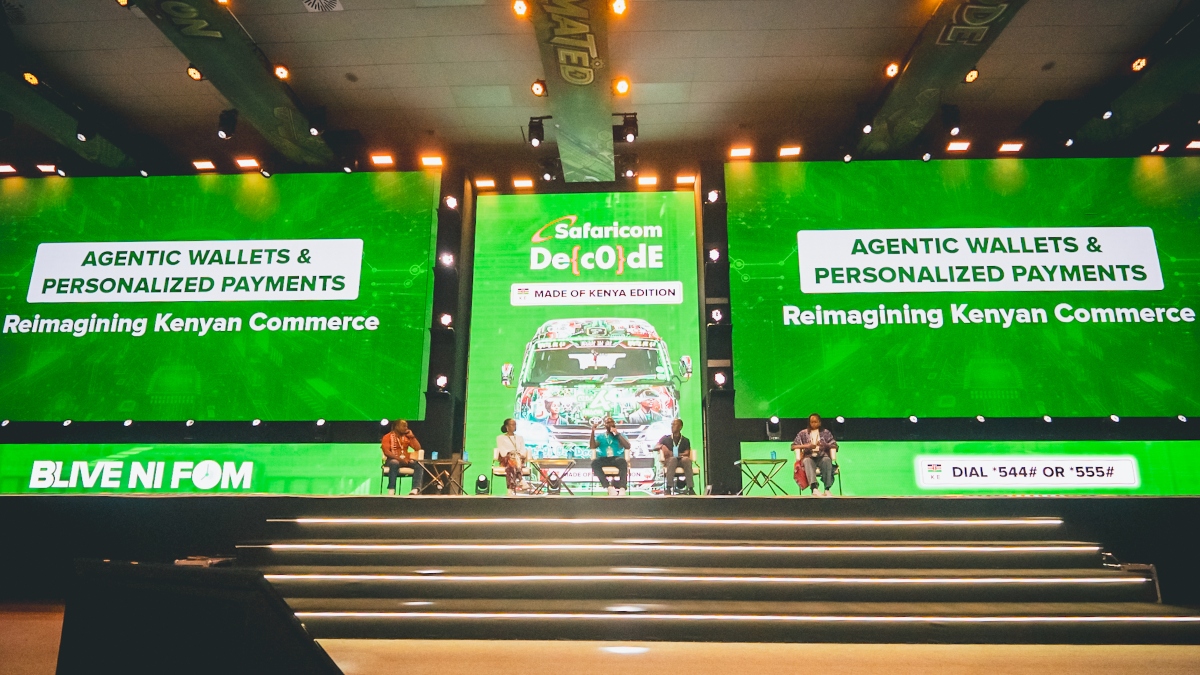
He emphasised that Safaricom’s role is to provide the foundational “rails” upon which new financial and technological solutions can be built, shifting the company from a service provider to a key enabler of innovation.
The Global Shift: AI Meets APIs
The urgency of this transition was echoed by Jack Ngare, who highlighted a global shift in how digital systems are being designed.
He noted that APIs and AI are increasingly working together to define modern software ecosystems, replacing traditional, rule-based systems with more adaptive, intelligent architectures.
In these emerging systems, AI generates insights and predictions, while APIs connect those insights to real-world functions such as payments, identity verification, and compliance. This convergence is enabling the rise of “agentic ecosystems,” where AI-driven tools can independently analyse, decide, and execute tasks across platforms.

Within financial services, this could transform areas such as fraud detection, credit scoring, compliance, and personalised financial advice, all operating in near real time.
Enter FinTech 2.0
Safaricom’s response to this shift is what it calls FinTech 2.0, a redesigned financial ecosystem outlined by Chief Financial Services Officer Esther Waititu.
She explained that after nearly two decades of expanding financial access through M-PESA, the company is now focused on improving financial outcomes.
“Digital inclusion was the foundation; financial health is the destination,” she said.

To support this transition, Safaricom has upgraded its infrastructure significantly. The system now operates on a multi-tenant architecture, integrates AI into its core, and has scaled its transaction capacity from around 100 transactions per second to approximately 6,000.
This expansion reflects a broader shift, with M-PESA increasingly functioning as a national payments backbone rather than a telecom product.
Building a Digital Lifestyle Ecosystem
On top of this infrastructure sits a growing ecosystem that includes investment platforms, credit services, insurance products, and merchant solutions.
This signals Safaricom’s ambition to go beyond payments and create a full digital lifestyle ecosystem that supports multiple aspects of users’ financial lives.
APIs as Economic Multipliers
Central to this strategy is Daraja 3.0, Safaricom’s API platform, which has already enabled tens of thousands of integrations.
By opening up its systems to developers and businesses, Safaricom aims to accelerate innovation across sectors.

Gichangi stressed that collaboration will be key to unlocking this potential, noting that the company cannot build everything alone. Instead, it seeks to empower an ecosystem where startups and enterprises can create solutions using its infrastructure.
This approach effectively turns the financial system into a programmable environment, where services such as lending, payments, and insurance can be seamlessly integrated into digital platforms.
From Financial Access to Economic Growth
The broader ambition is to move Kenya’s digital economy from basic financial access toward wealth creation and resilience.
While the first phase of mobile money focused on enabling transactions, the next phase is expected to support investment, credit access, and long-term financial growth.