
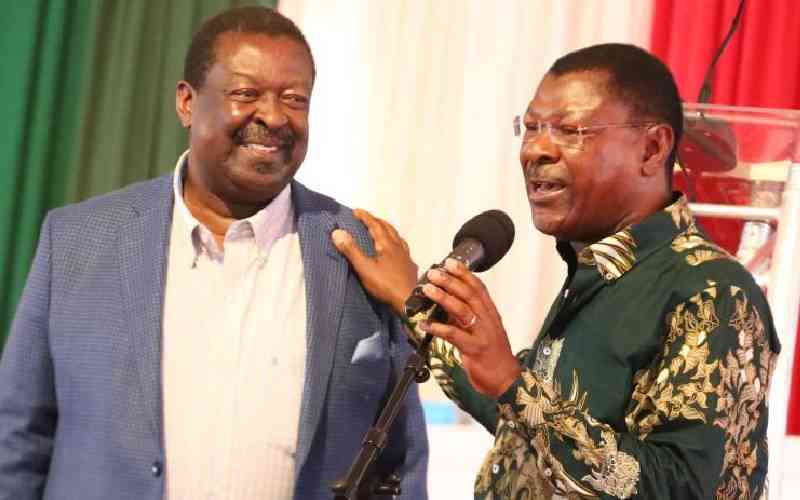
Dr Moses Wetang’ula (right) and Prime CS Musalia Mudavadi…Photo/CG
Kakamega,Kenya
Western Kenya’s political entry into President William Ruto’s administration has delivered a visible concentration of senior government appointments, but growing scrutiny now points to a widening gap between representation at the top and tangible benefits at the grassroots.
The arrangement, politically anchored by National Assembly Speaker Moses Wetang’ula and Prime Cabinet Secretary Musalia Mudavadi, was widely framed during the 2022 political realignment as part of a broader power-sharing balance that would secure significant influence for Western Kenya within the executive.
However, nearly two years into the administration, questions are emerging over whether that influence has translated into institutional control, economic penetration, or equitable distribution of state opportunities.
Visible power at the top, limited reach below
Western Kenya now holds several high-profile positions across Cabinet, the civil service, and state corporations.
Key appointments include:
- Dr. Deborah Mulongo – Cabinet-level role in the Health docket and then to Environment docket following reshuffles
- Ambassador Ababu Namwamba – Former Cabinet Secretary for Sports and Creative Economy, now serving in a diplomatic posting in Uganda
- Harry Kimtai – Principal Secretary, State Department for Mining
- Dr.Beatrice Inyangala – Principal Secretary, Higher Education and Research
- Dr. Juma Mukhwana – Principal Secretary, Industry
- Jane Kere Imbunya – Principal Secretary, Public Service and Human Capital Development
- Susan Auma Mang’eni – Principal Secretary, MSMEs Development
Additional senior administrative roles include Principal Administrative Secretaries in key ministries such as Interior and Treasury.
While these appointments appear numerically significant, analysts note that most fall within the administrative layer rather than decision-making positions that directly control procurement flows, parastatal leadership, or county-linked development financing.
Institutional influence concentrated but not fully leveraged
Western Kenya also holds strategic positions in key state institutions, including:
- Director of Public Prosecutions (DPP) Renson Ingonga
- Ethics and Anti-Corruption Commission Chair Bishop Dr. David Oginde
- Kenya Revenue Authority Commissioner-General Humphrey Wattang’a
- CBK Board Chair Andrew Mukite Musangi
- Kenya Institute for Public Policy Research and Analysis (KIPPRA) Board Chair Prof. Paul Wachana
- Nuclear Power and Energy Agency CEO Justus Wabuyabo
- National Standards Council Chair Dr. Chris Wamalwa
- Youth Advisory Board Chair Sophie Nekoye Waliaula
- Air Force Commander Major General Benard Waliaula
These positions place individuals from the region within powerful state institutions overseeing law enforcement, taxation, policy research, energy and national standards.
However, critics argue that institutional presence has not been matched by coordinated regional leverage or visible downstream impact in Western Kenya counties.
Diplomatic postings raise further questions
The region is also represented in Kenya’s foreign service through ambassadorial appointments, including:
- Ken Nganga – Ambassador to the United Arab Emirates
- Prof. Anne Kisaka Nangulu – Ambassador to Senegal
- Dr. Susan Nakhumicha – Permanent Representative to the United Nations
- Edwin Afande – Ambassador to Vienna
- Ambassador Ababu Namwamba – Diplomatic posting in Uganda
Despite their strategic importance, diplomatic appointments have largely remained outside domestic political scrutiny, with limited visible linkage to regional development outcomes or structured lobbying for local economic opportunities.
The accountability question shifts downward
The growing political debate is increasingly shifting away from whether Western Kenya is represented in government, toward what that representation has produced.
Critics argue that while top-level appointments are evident, there is limited evidence of coordinated action to secure:
- parastatal board leadership
- procurement and contracting influence
- mid-level civil service penetration
- regionally targeted development projects
This has triggered a second layer of scrutiny directed not only at appointing authorities, but at senior officeholders themselves.
Blame shifting: from State House to implementation layer
While political discourse often directs responsibility toward President William Ruto and regional power brokers Speaker Wetang’ula and Prime CS Mudavadi, analysts note that the structure of government places significant operational responsibility on Cabinet Secretaries, Principal Secretaries, and heads of institutions.
These officials control administrative execution, hiring pipelines, and institutional prioritization—areas where critics say Western Kenya appointees have not acted in a coordinated bloc.
The result, according to political observers, is a disconnect between symbolic representation at the top and functional influence in the middle and lower tiers of government.
One year to elections, pressure builds
With the next general election approaching, scrutiny over the so-called “30% arrangement” is intensifying.
Voters in Western Kenya are increasingly asking whether political alignment has translated into measurable outcomes such as employment opportunities, infrastructure expansion and institutional representation beyond headline appointments.
Unless tangible results emerge from the current network of senior appointees, analysts warn that the narrative of political inclusion could shift into one of unmet expectations.
Conclusion
Western Kenya’s presence in government is no longer in question. What remains under scrutiny is whether that presence has been effectively converted into influence, coordination and delivery.
As it stands, the debate is no longer about access to power—but about how that power has been used, by those who already hold it.