

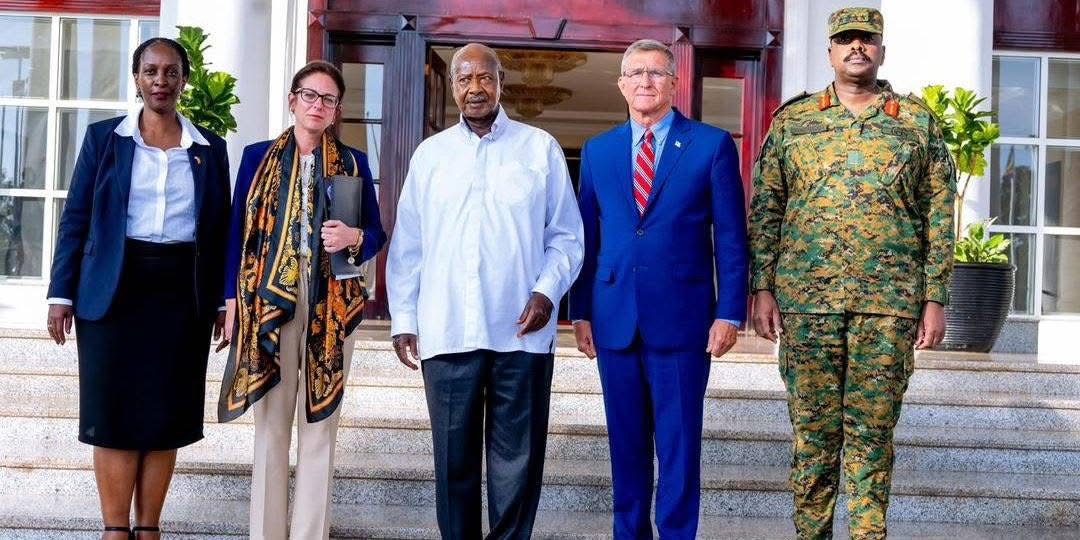
President Yoweri Museveni meets US Retired Army Lt. Gen. Michael T. Flynn at Statehouse Entebbe…Photo/courtesy
ENTEBBE, Uganda
Retired U.S. Army Lt. Gen. Michael T. Flynn met Ugandan President Yoweri Kaguta Museveni at State House Entebbe in a visit highlighting renewed momentum in security cooperation between Uganda and the United States.
Flynn, a former director of the Defense Intelligence Agency and U.S. national security adviser, is in Uganda at the invitation of Chief of Defence Forces Gen. Muhoozi Kainerugaba.
His visit has centered on leadership development and expanding military-to-military ties, according to Ugandan officials.
During the meeting, Museveni and Flynn discussed regional security dynamics in East and Central Africa, underscoring cooperation on counterterrorism, intelligence sharing and military training.
Kikwete Appointed AU Envoy, Celebrated for Role in Kenya’s 2008 Peace Talks
Flynn praised the reception he received, while Ugandan officials framed the engagement as part of a broader push to deepen bilateral defense ties.
Also present was Uganda’s ambassador to Washington, Robie Kakonge.
Flynn’s itinerary included a private meeting with Kainerugaba, a dinner in his honor and an address to senior UPDF officers at Speke Resort Munyonyo, where he emphasized leadership rooted in character, courage and strategic vision.
Gen. Kainerugaba described the visit as a step toward building a “meaningful and enduring partnership.”
But the outreach comes as Uganda’s political tensions continue to draw scrutiny abroad.
Opposition leader Bobi Wine, whose real name is Robert Kyagulanyi, has been in the United States raising concerns over what he describes as repeated electoral injustices and democratic backsliding under Museveni’s long rule.
Wine has maintained that past elections were marred by irregularities, allegations the Ugandan government has consistently denied.
The parallel developments — Flynn’s high-level security engagement in Entebbe and Wine’s advocacy tour in the United States — reflect the complex balancing act in Washington’s relationship with Kampala.
TUJU HEALTH SCARE DRAMA: Former Power Broker Rushed to Hospital as Mystery Deepens
On one hand, Uganda remains a strategic security partner for the U.S., particularly in regional peacekeeping and counterterrorism operations.
On the other, concerns over governance, human rights and electoral credibility continue to shape political discourse and influence how that partnership is perceived internationally.
Analysts say the dual track underscores a familiar U.S. foreign policy dilemma: maintaining security alliances in volatile regions while navigating pressure to uphold democratic values.
For Uganda, the implications are equally significant.
Deepening military cooperation may reinforce its regional influence and security capacity, but persistent political disputes risk complicating its international standing, especially as opposition voices amplify their concerns on global platforms.
As both engagements unfold, they highlight a widening contrast between state-to-state cooperation and citizen-led calls for political reform — a dynamic likely to continue shaping Uganda-U.S. relations in the months ahead.